
Water Temperature and Cut Flower Hydration
Research Update February 2026, powered by FloraLife
Garry Legnani, Ph.D. – Senior Postharvest Scientist, FloraLife
Background:
I am often asked if it’s better to hydrate flowers in warm or cold water. There is a common belief in the floral industry that flowers hydrate faster at room temperature than in the flower cooler. Cut flower hydration is a dynamic process driven by transpiration (evaporation of water from the leaves) through the stomata and how easily water can enter and move up the stem. The balance between water loss from transpiration and uptake by the cut end of the stem is influenced by environmental factors such as temperature, light, and relative humidity; and physiological factors such as leaf size, the number of functioning stomata, and stem blockage by microbes, air bubbles, and sugary/waxy substances that coat the end of the stem.
Because of these factors, it is important to define the conditions of how we are conducting the test when we evaluate the effects of temperature on cut flower hydration.
Condition #1. The effect of water temperature (2°C/36°F vs 20°C/68°F) when the flowers are hydrated at room temperature (20°C/68°F air temperature) and the air temperature, relative humidity, and airflow are the same. In this case we are looking only at the effects of the water temperature.
Condition #2. The effect of water temperature when hydrating the flowers in the cooler (2° C/36°F air temperature) compared with hydrating outside the cooler (20°C/68°F air temperature) where the air temperature, relative humidity, and airflow are different.
For this research update we wanted to collect data on cut flower hydration under both these conditions. First, we looked at the effect of water temperature under condition #1 by comparing the fresh weight (FWT) gain and flower head temperatures after 1 hour and 4 hours in water that is 2°C/36°F or 20°C/68°F, and the flowers are hydrated outside the cooler (20°C/68°F air temperature). Next, we looked at the effect of water temperature under condition #2 by comparing FWT gain and the volume of water uptake by comparing hydration in the flower cooler (2°C/36°F air temperature) vs room temperature (20°C/68°F air temperature).
Methods:
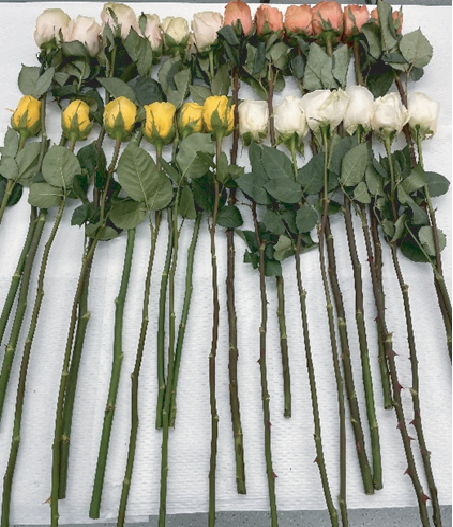
The cultivars Brighton, Kahala, Pink Mondial, and Vendela received dry packed in a mixed box from a farm in Ecuador. Stems were randomized into treatment groups, stripped to a uniform set of leaves. Stems were recut and assembled into 6 bouquets of 8 stems (two stems of each cultivar) and the initial fresh weight (g) of each bouquet was recorded. After weighing, the bouquets were placed in buckets containing 2 L of standardized water at a temperature of 2°C/36°F or 20°C/68°F. The water used for the treatments was allowed to equilibrate overnight in the cooler or room temperature.
For the water temperature comparison experiment, the test was done at room temperature (20°C/68°F air temperature) under fluorescent lighting and a relative humidity of 36% so all the flowers were hydrating under the same conditions. After 1-hour, stems were re-weighed and returned to their buckets. Water temperatures at the time of weighing were recorded. Four stems of each cultivar were randomly chosen from each bouquet, and the flower head temperature was measured using an Atkins Aqua Tuff 351 needle thermometer. The thermometer was inserted into the center of the flower head until resistance was detected. At 4-hours, bouquets were re-weighed. The temperature of the water in the 2°C/36°F treatment was measured every hour for 4 hours to determine the temperature at the time of weighing and the increase in water temperature over time.
After 4-hours, the bucket of stems containing flowers hydrated in 2°C/36°F was moved to the flower cooler (2°C/36°F air temperature and 68% RH), while the flowers hydrated in the 20°C/68°F water remained on the bench in the postharvest lab (20°C/68°F air temperature and 36% RH). After approximately 18 hours, bouquets from each treatment were re-weighed then returned to the flower cooler or the postharvest bench. After approximately 72 hours, the volume of water (ml) left in the bucket of each hydration treatment was determined.
Data Calculations:
- FWT gain per bouquet in mg/g FWT after 1 hour = (FWT T1– FWT T0/FWT T0) x 1,000
- FWT gain per bouquet in mg/g FWT after 4 hours = (FWT T4– FWT T0/FWT T0) x 1,000
- FWT gain per bouquet in mg/g FWT after 18 hours = (FWT T18– FWT T0/FWT T0) x 1,000
- Water uptake (ml) after 72 hours = 2,000 – water volume (ml) in bucket after 72 hours
Results:
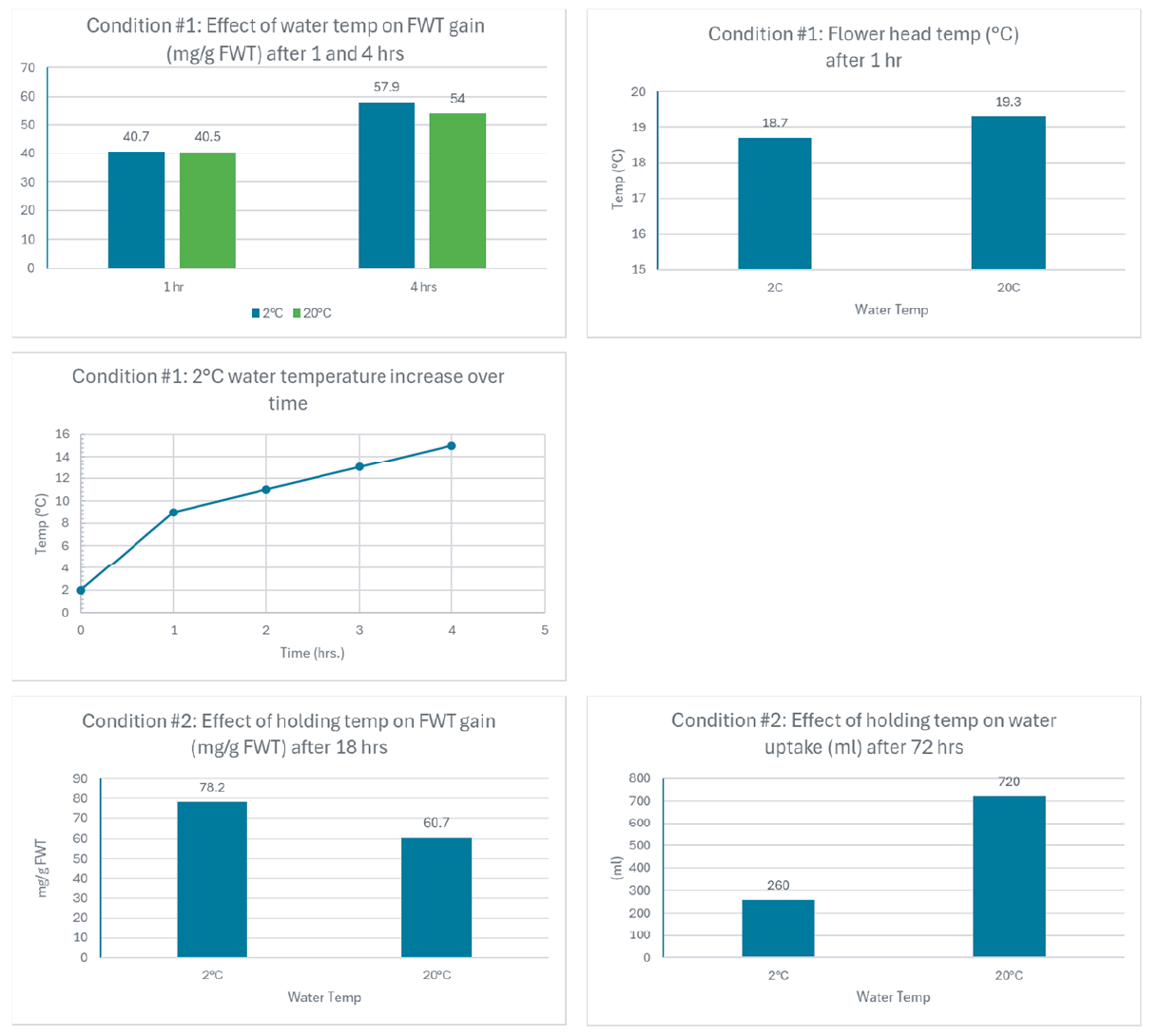
- No difference in bouquet FWT gain (mg/g FWT) was observed between 2°C/36°F and 20°C/68°F water after 1 and 4 hours.
- Flowers hydrated in 2°C/36°F water showed a reduction in flower head temperature of 0.6°C – this difference was statistically significant.
- The 2°C/36°F water showed a sharp increase in temperature during the first hour then showed a linear increase of 2°C/36°F per hour for 4 hours when held at room temperature (20°C/68°F).
- After 18 hours, bouquets stored in the cooler (2°C/36°F) showed a FWT increase of 17 mg/g FWT compared to bouquets left at room temperature (20°C/68°F).
- After 72 hours, bouquets stored in the cooler (2°C/36°F) showed a 64% reduction in water uptake compared to bouquets kept at room temperature (20°C/68°F).
Conclusion:
Under condition #1 when air temperature and relative humidity were kept constant, water temperature (2°C/36°F or 20°C/68°F) had no effect on bouquet FWT gain (mg/g FWT); however, a statistically significant difference in flower head temperature was observed indicating that chilled hydration water can lower the temperature of the flower head. Under condition #2 when light levels, air temperature, and RH were different (12-hrs fluorescent light/20°C/36% RH for the postharvest room; darkness/2°C/68% RH for the flower cooler), bouquets stored in the cooler showed increased FWT while using less water. We attribute this more efficient water usage in the cooler to reduced transpiration under low light, higher RH, and low temperatures slowing flower development and energy demands. The opposite conditions affected the flowers left outside the cooler, demonstrated by the increased flower opening at room temperature. Based on these results we can confidently recommend that unless you are trying to forcibly open flowers for an event or floral design, cold water hydration is best for flowers.
Photos:
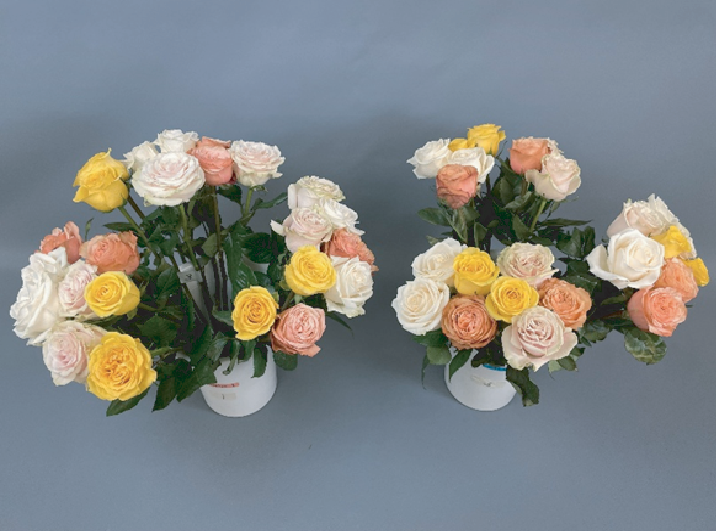
Flowers held at 20°C showed increased opening
*Product availability depends upon geographical region